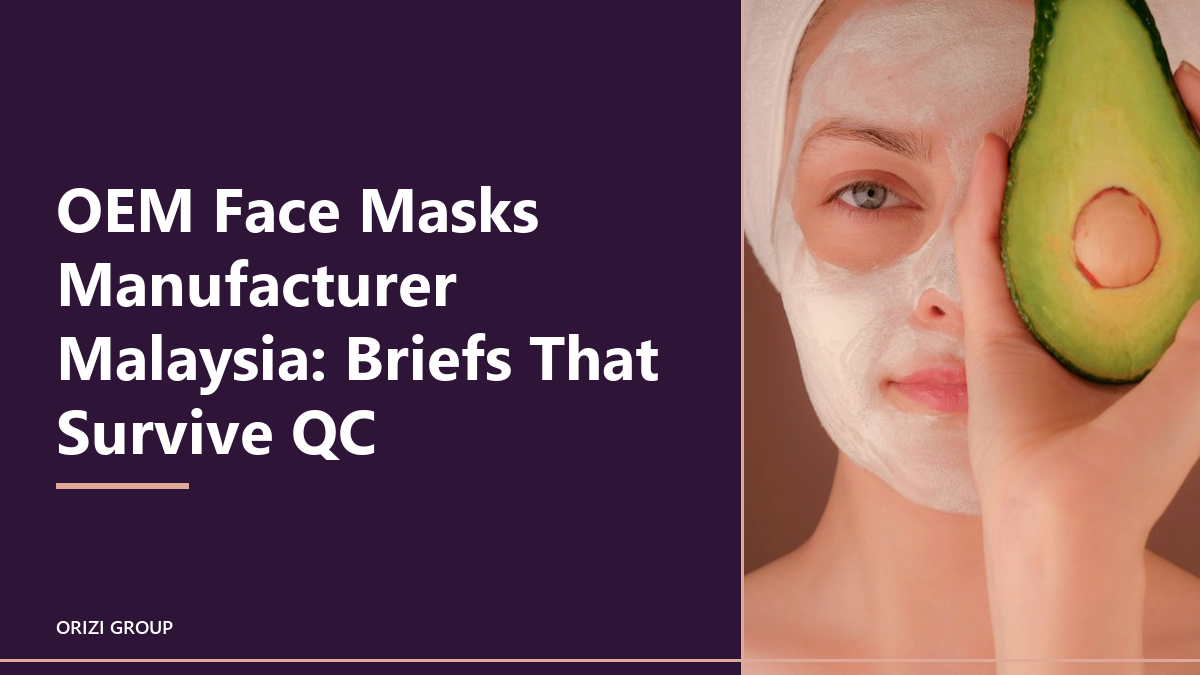
A sheet mask looks simple until the sachet arrives leaking or the essence separates on the shelf. Most failures trace back to a brief that named a material and a scent but never specified the numbers. This is the level of detail an OEM face masks manufacturer needs before quoting.
What a Sheet Mask Brief for an OEM Face Masks Manufacturer Malaysia Must Specify
Essence load in grams, sheet material and thickness, sachet format, fill tolerance and the shelf life you expect. A brief to an OEM face masks manufacturer Malaysia team should carry numbers, not adjectives.
Essence load decides everything downstream. Too little and the sheet feels dry on the second use; too much and the sachet bulges, leaks and fails a drop test. Specify grams per sheet rather than a percentage, and test the sealed pack instead of the raw liquid.
Add the claim you intend to print. A brightening claim needs actives at a level that survives the sheet, and a calming claim needs the fragrance decision settled early, because fragrance is the most common cause of a failed patch test.
Which Formats an OEM Face Masks Manufacturer Can Run
Cotton, cupro, hydrogel and bio-cellulose covers most of the market, each with a different cost and a different machine.
Sheet material changes the experience more than the formula does. Cotton feels familiar and dries quickly, cupro drapes better, hydrogel photographs well and costs more. Feel the same essence on three materials before choosing, because a catalogue swatch says nothing about fit.
Hydrogel holds less essence but photographs better; cotton is cheapest and dries faster. Ask to see the same essence run on two materials before choosing, because the feel on skin does not match the swatch in a catalogue.
Ask for the sheet weight in grams per square metre. Two masks that look identical in a photograph can differ enough in weight that one feels like a wipe and the other feels like a treatment.
How Do You Test a Mask From an OEM Face Masks Manufacturer Before Scaling?
Accelerated stability on the filled sachet, a challenge test on the essence, and a patch test with the actual sheet in contact. Ask for the seal test report, not just the swatch.
Seal integrity catches most of the real problems. A sachet that passes a visual check can still fail under pressure, and that failure appears as a leaking carton in a warehouse rather than as a defect on the line where it could be traced.
Test the sealed sachet, not the raw essence. Most leaks appear at the seal, not in the formula, and a seal problem discovered after ten thousand units is a write-off rather than a tweak.
Where Packaging Leaks Margin
Foil thickness, the notch position and the carton weight, three lines that look trivial on a quotation.
Freight is where a thin foil shows up. A laminate that saves a few sen per unit can turn a pallet into a claim, and the saving is counted in thousands while the claim is counted in tens of thousands.
A thinner foil saves cents per unit and costs a percentage of every pallet in transit damage. Specify the laminate and the tear notch in the purchase order, not just in conversation.
Print the lot number and the expiry on the sachet itself, not only on the carton. Sachets separate from cartons in every warehouse, and a sachet without a date cannot be sold, returned or traced.
Who Signs the Stability Report?
The factory’s quality lead signs it, and your brand accepts it, which is why the report has to be readable by someone who is not a chemist.
Ask for a one-page summary with the conclusions first. A fifty-page appendix with no summary is a document nobody reads, and an unread document is not a safeguard.
Ask for the conclusions page first. A report that opens with method and buries the result on page forty is written to be filed rather than read, and a filed report protects nobody when a batch is questioned.
Keep the stability summary with the artwork file. When a marketplace or a distributor asks for evidence two years later, the document that answered the question the first time will answer it again.
Masks are also the easiest entry into a private label skincare OEM Malaysia line, because a single sachet needs no pump, no carton insert and no glass. ORIZI Group runs them alongside serums and creams, so a brand can test a mask and a serum in the same order. Each mask format is documented on orizigroup.com. The OEM Skincare range beside it is briefed the same way.